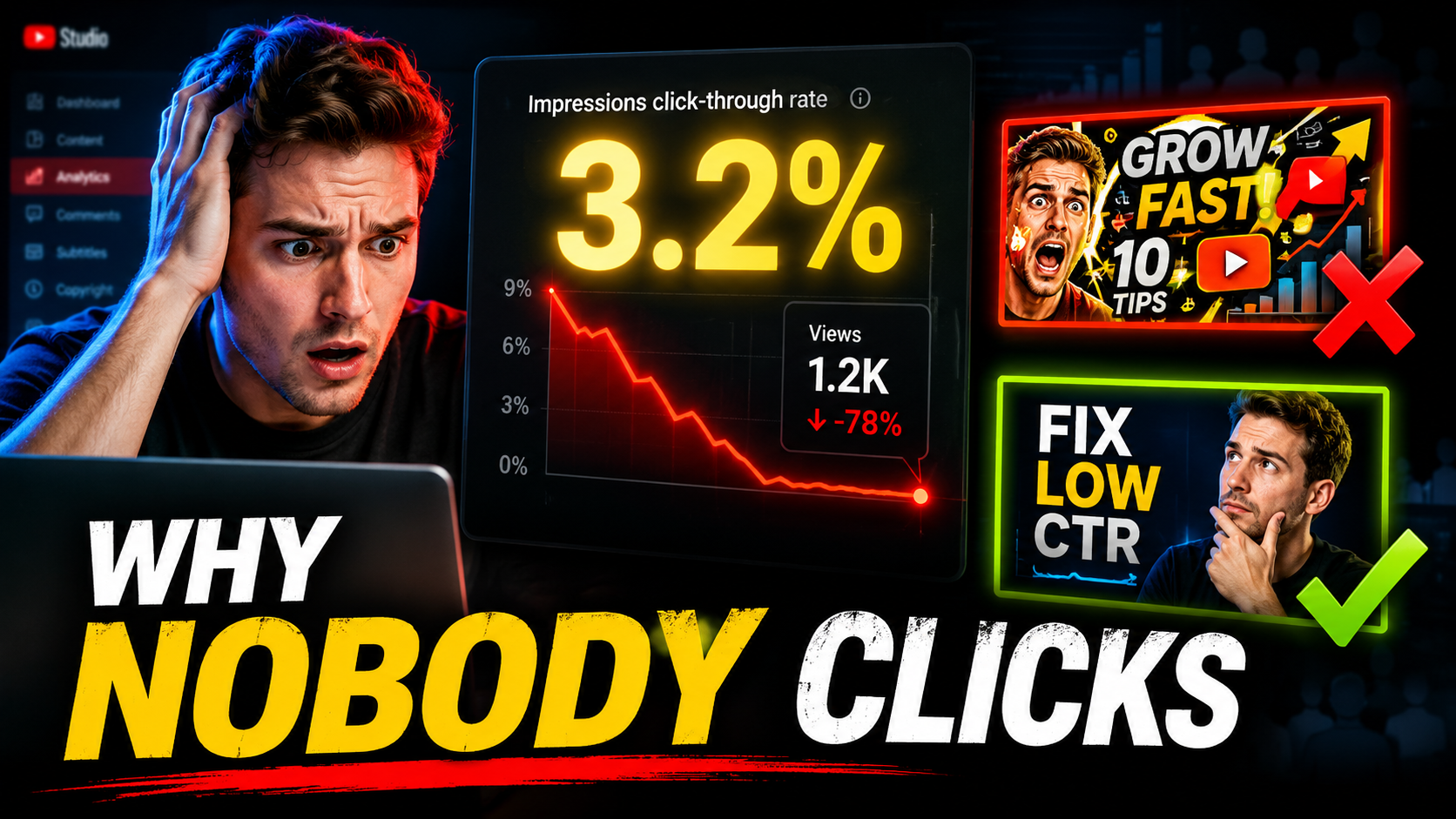
YouTube CTR is one of those numbers creators obsess over, misunderstand, celebrate too early, and panic over too fast.
One upload gets a 9% CTR and barely moves. Another gets a 3.5% CTR and keeps pulling views for weeks. One thumbnail looks beautiful but nobody clicks. Another looks almost too simple, yet somehow wins. That is the strange little battlefield of YouTube click-through rate.
CTR matters because it tells you one important thing:
When YouTube shows your video to someone, does your title and thumbnail make them care enough to click?
That is the job.
Not to impress other creators. Not to win a design award. Not to make the thumbnail look expensive. The job of your packaging is to stop the scroll, create a clear reason to watch, and make the viewer feel like skipping the video would cost them something.
But CTR is not magic. It is not the whole YouTube algorithm. It is not a guarantee that a video will take off. CTR is the first handshake. Retention, satisfaction, topic demand, audience match, and competition decide whether the relationship goes anywhere after that.
This guide breaks down what YouTube CTR means, what a good CTR looks like, why CTR changes, and how to improve it without using cheap clickbait that burns trust.
What Is YouTube CTR?
YouTube CTR stands for click-through rate.
In simple terms, it shows how often viewers clicked and watched your video after seeing your thumbnail on YouTube.
If YouTube shows your thumbnail to 1,000 people and 60 people click, your CTR is 6%.
The basic idea looks like this:
CTR = clicks from impressions ÷ impressions
So when creators talk about CTR, they are really talking about how well their video packaging performs. Your title, thumbnail, topic, audience, and traffic source are all wrapped inside that number.
A high CTR usually means the video looks interesting to the people seeing it.
A low CTR usually means one of three things:
The topic is not compelling enough.
The title does not create enough reason to click.
The thumbnail is not clear, emotional, or specific enough.
Sometimes the issue is not the thumbnail at all. Sometimes YouTube is showing your video to a broader audience that does not know you yet. That can lower CTR even while the video is actually growing.
That is why CTR needs context. Always.
Why YouTube CTR Matters
CTR matters because every YouTube video has to win attention before it can win watch time.
Your video might have a great story, useful advice, strong editing, or a perfect ending, but none of that matters if people never click in the first place. The title and thumbnail are the front door. If the front door looks boring, confusing, or fake, viewers walk past.
This is especially brutal on YouTube because your video is never alone.
It is competing against:
Other creators in your niche Bigger channels with stronger trust Trending topics Better thumbnails Clearer titles Videos the viewer already planned to watch Recommendations from creators they already know
That is why CTR is not just a design metric. It is a competitive signal.
A strong CTR means your video earned attention in a crowded feed. A weak CTR means the viewer saw it and decided something else looked more worth their time.
That sounds harsh, but it is useful. CTR gives you feedback before the viewer ever hears your intro.
Know before you publish.
TubeSignalHQ audits your thumbnail, title & hook before your video goes live — so you fix packaging mistakes before viewers see them.
Analyze Your YouTube Packaging →What Is a Good YouTube CTR?
A good YouTube CTR depends on your niche, audience, video topic, traffic source, channel size, and how widely YouTube is testing the video.
Many videos fall somewhere around the 2% to 10% range, but that range should not be treated like a law. A small channel with a loyal audience may see higher CTR early because the first viewers already know the creator. A video that gets pushed to a much wider audience may see a lower CTR because it is being tested beyond the core fan base.
That is not always bad.
A video with 9% CTR and 2,000 impressions may be doing well with your loyal viewers.
A video with 4% CTR and 100,000 impressions may be doing better overall because YouTube found a much larger audience for it.
The mistake is judging CTR by itself.
A better question is:
Is the video getting enough impressions, clicks, watch time, and viewer satisfaction together?
CTR gets the viewer in the door. The video still has to keep them there.
Why CTR Changes Over Time
CTR usually changes as YouTube tests your video with different groups of people.
Early on, your video may be shown to subscribers, returning viewers, or people who already watch similar content. These viewers are more likely to click because they already have some trust or interest.
If the video performs well, YouTube may test it with a wider audience. That larger audience may not know you. They may be colder, less familiar, less committed, or simply less interested in your topic.
As that happens, CTR can drop.
That drop can scare creators, but it does not always mean the video is failing. Sometimes it means the video is leaving the small pond and swimming into deeper water.
This is why you should never judge a video too early.
Checking CTR ten minutes after upload is a good way to give yourself fake confidence or fake anxiety. Let the video gather enough impressions first. Then compare it against similar videos, similar traffic sources, and similar audience conditions.
CTR is a signal. It is not a verdict from the gods.
The Main Factors That Affect YouTube CTR
CTR is not caused by one thing. It is the result of several signals working together.
1. The Topic
The topic is the foundation.
A weak topic with a beautiful thumbnail is still fighting uphill. A strong topic with clear demand can survive imperfect packaging.
Creators often blame thumbnails when the real problem is that the video idea does not create enough curiosity, urgency, usefulness, or emotional pull.
Before fixing the thumbnail, ask:
Would the right viewer actually care about this idea?
If the answer is no, better design will not save it.
2. The Title
The title tells the viewer what they are about to get.
A strong YouTube title is clear, specific, and emotionally loaded without being dishonest. It gives the viewer a reason to click now.
Weak titles are usually too vague.
Examples of weak title patterns:
How to Grow on YouTube My YouTube Tips Thumbnail Advice YouTube Analytics Explained
These are not terrible, but they are flat. They sound like homework.
Stronger title angles usually create a sharper promise:
Why Your YouTube CTR Drops After Upload The Thumbnail Mistake Killing Your Clicks How to Fix Low YouTube CTR Without Clickbait Why High CTR Still Does Not Guarantee Views
Those titles work better because they point to a real creator problem.
3. The Thumbnail
The thumbnail has one job: make the idea instantly visible.
Not pretty. Visible.
A thumbnail should communicate the emotional point of the video before the viewer reads the title. If someone has to squint, decode, or study the image, it is probably too complicated.
Good thumbnails usually have:
One clear subject Strong contrast A simple emotional cue Readable visual hierarchy A clear connection to the title No unnecessary clutter
Bad thumbnails often have too many words, too many objects, weak contrast, tiny faces, confusing screenshots, or no obvious reason to care.
The thumbnail should not repeat the title word for word. It should support the title from a different angle.
If the title creates the question, the thumbnail should create the feeling.
4. The Audience Match
A great video shown to the wrong audience will look like a bad video.
CTR depends heavily on who sees the impression. A video about advanced YouTube analytics may perform well with serious creators but poorly with casual viewers. A video about beginner thumbnail mistakes may perform well with small creators but feel too basic to experienced channel managers.
This is why CTR should be compared against audience context.
The same thumbnail can win with one audience and fail with another.
5. The Traffic Source
CTR behaves differently depending on where the impression happens.
Search traffic is often higher intent. The viewer is looking for something specific. If your video matches the query, they have a clear reason to click.
Home and Suggested traffic are more competitive. The viewer may not be searching for your topic. Your video has to interrupt passive browsing and earn curiosity.
That means a “good” CTR in Search may look different from a “good” CTR on Home or Suggested.
Do not judge all CTR numbers the same way. The surface matters.
Know before you publish.
TubeSignalHQ audits your thumbnail, title & hook before your video goes live — so you fix packaging mistakes before viewers see them.
Analyze Your YouTube Packaging →How to Improve YouTube CTR
Improving CTR starts before you design the thumbnail.
It starts with the idea.
Start With a Clickable Problem
The best CTR improvements usually come from choosing sharper video ideas.
Instead of:
YouTube CTR Tips
Use a stronger problem:
Why Your YouTube CTR Is Low Even With Good Thumbnails
Instead of:
How to Make Better Titles
Use:
The Title Mistake That Makes Viewers Ignore Your Videos
Instead of:
Thumbnail Optimization Guide
Use:
Why Your Thumbnail Looks Good But Gets No Clicks
The difference is pain.
The stronger versions speak to something the creator has actually felt. Confusion. Frustration. Disappointment. The ugly little moment when you publish a video, refresh Studio, and realize nobody is biting.
That is human. That gets clicks.
Make the Title Specific
Specific titles beat generic titles because they reduce uncertainty.
A viewer should know exactly why the video is worth opening.
Weak:
Improve Your YouTube Videos
Better:
Fix Low YouTube CTR With Better Titles and Thumbnails
Strong:
Why Your YouTube CTR Is Low and How to Fix Your Packaging
Specific does not mean long. It means clear.
Build Thumbnail and Title as a Pair
Do not create the title first and then slap a thumbnail on it later.
They should work together.
Example:
Title: Why Your YouTube CTR Drops After Upload Thumbnail Text: CTR CRASH? Visual: A YouTube analytics line dropping after an early spike
That works because the title explains the problem and the thumbnail makes the problem feel immediate.
Another example:
Title: High CTR, Low Views: What Went Wrong? Thumbnail Text: NOT ENOUGH? Visual: A high CTR number beside low impressions
That creates a clean contradiction. The viewer clicks because the situation feels familiar and unresolved.
Use Contrast
CTR lives in contrast.
Before and after. Good versus bad. High CTR but low views. Beautiful thumbnail but poor clicks. Small channel beating bigger channels. A video that should have worked but failed.
Contrast gives the viewer a reason to lean in.
Flat ideas feel complete. Contrasting ideas feel unfinished.
And unfinished ideas get clicks.
Remove Clutter
Most thumbnails fail because they try to say too much.
The viewer is scrolling fast. You do not have room for five objects, three faces, tiny charts, a long phrase, and a background full of noise.
A better thumbnail is usually the result of removing things.
Remove extra words. Remove extra icons. Remove extra screenshots. Remove weak background details. Remove anything that does not help the click.
If the thumbnail still makes sense when it is small, you are closer.
Match the Promise to the Video
This is where creators need discipline.
Clickbait can raise CTR in the short term, but it damages the video if viewers leave quickly. If the title promises one thing and the video delivers another, retention suffers. When retention suffers, the video loses momentum.
The goal is not to trick the click.
The goal is to earn the click and reward it.
A strong title and thumbnail should make the viewer think:
That looks interesting.
Then the first 30 seconds should make them think:
Good. This is exactly what I came for.
Common YouTube CTR Mistakes
The first mistake is changing thumbnails too fast.
Creators often panic within the first few hours and start swapping titles and thumbnails before the video has enough data. That makes it harder to know what actually worked.
The second mistake is comparing every video against your best performer.
Your best video may have had a stronger topic, better timing, better audience match, or less competition. Use it as a clue, not a weapon against every future upload.
The third mistake is chasing CTR while ignoring retention.
A video with high CTR and poor retention usually means the packaging overpromised. People clicked, realized the video was not what they expected, and left.
That is not a packaging win. That is a trust leak.
The fourth mistake is making thumbnails for creators instead of viewers.
Other creators may admire detail. Viewers reward clarity.
The fifth mistake is treating CTR as one universal number.
CTR from Search is different from CTR from Browse. CTR from subscribers is different from CTR from cold viewers. CTR on a niche video is different from CTR on a broad topic.
Context is the difference between insight and nonsense.
High CTR Is Not Enough
A high CTR feels good, but it does not guarantee growth.
YouTube does not only care whether people click. It also cares what happens after the click.
Do viewers stay?
Do they watch long enough?
Do they seem satisfied?
Do they continue watching more videos?
Does the video perform well compared with other videos that viewer could watch?
This is why the best creators do not optimize only for CTR. They optimize for the full package:
Topic demand Title clarity Thumbnail curiosity Opening hook Retention Viewer satisfaction Session flow Repeatable audience interest
CTR opens the door. Retention keeps the room full.
Know before you publish.
TubeSignalHQ audits your thumbnail, title & hook before your video goes live — so you fix packaging mistakes before viewers see them.
Analyze Your YouTube Packaging →How TubeSignalHQ Helps Improve YouTube CTR
TubeSignalHQ is built around one simple belief:
Creators should not have to guess why people are not clicking.
Most creators look at a low CTR and immediately blame the thumbnail. Sometimes they are right. Many times, they are not.
The issue might be the title.
It might be the topic.
It might be weak contrast.
It might be audience mismatch.
It might be that a competitor packaged the same idea better.
It might be that the video looks clickable to you because you made it, but unclear to someone seeing it cold for the first time.
TubeSignalHQ helps creators look at YouTube packaging more clearly. Instead of treating CTR like a mystery number, it connects the dots between titles, thumbnails, competitors, topics, audience intent, and performance signals.
That means creators can make smarter decisions before publishing, not just damage-control decisions after a video underperforms.
A better CTR strategy is not about guessing harder.
It is about building a repeatable packaging process.
YouTube CTR Improvement Checklist
Before publishing your next video, ask:
Is the topic something the target viewer already cares about?
Does the title create a clear reason to click?
Does the thumbnail communicate the idea quickly?
Do the title and thumbnail work together instead of repeating each other?
Is there emotional contrast or curiosity?
Is the promise honest?
Would a cold viewer understand the video in two seconds?
Does the opening of the video immediately deliver on the packaging?
Is this being judged against the right traffic source?
Have you waited for enough impressions before making changes?
If you cannot answer these clearly, the problem is probably not just CTR. The problem is packaging strategy.
Final Takeaway
YouTube CTR is not just a number in Studio.
It is a signal that tells you how well your video earns attention before the viewer ever presses play.
A better CTR does not come from louder thumbnails, longer titles, or desperate clickbait. It comes from understanding the viewer, choosing sharper ideas, creating clearer packaging, and making sure the video delivers on the promise that earned the click.
The best creators do not chase CTR blindly.
They study it. They compare it. They question it. They improve the packaging, then watch what the audience does next.
That is where growth starts.
Not with guessing.
With signal.
Know before you publish.
TubeSignalHQ audits your thumbnail, title & hook before your video goes live — so you fix packaging mistakes before viewers see them.
Analyze Your YouTube Packaging →